Percutaneous Nephrolithotomy (PCNL)
A keyhole surgical procedure designed to safely remove large or complex kidney stones.
Percutaneous Nephrolithotomy (PCNL)
A keyhole surgical procedure designed to safely remove large or complex kidney stones.
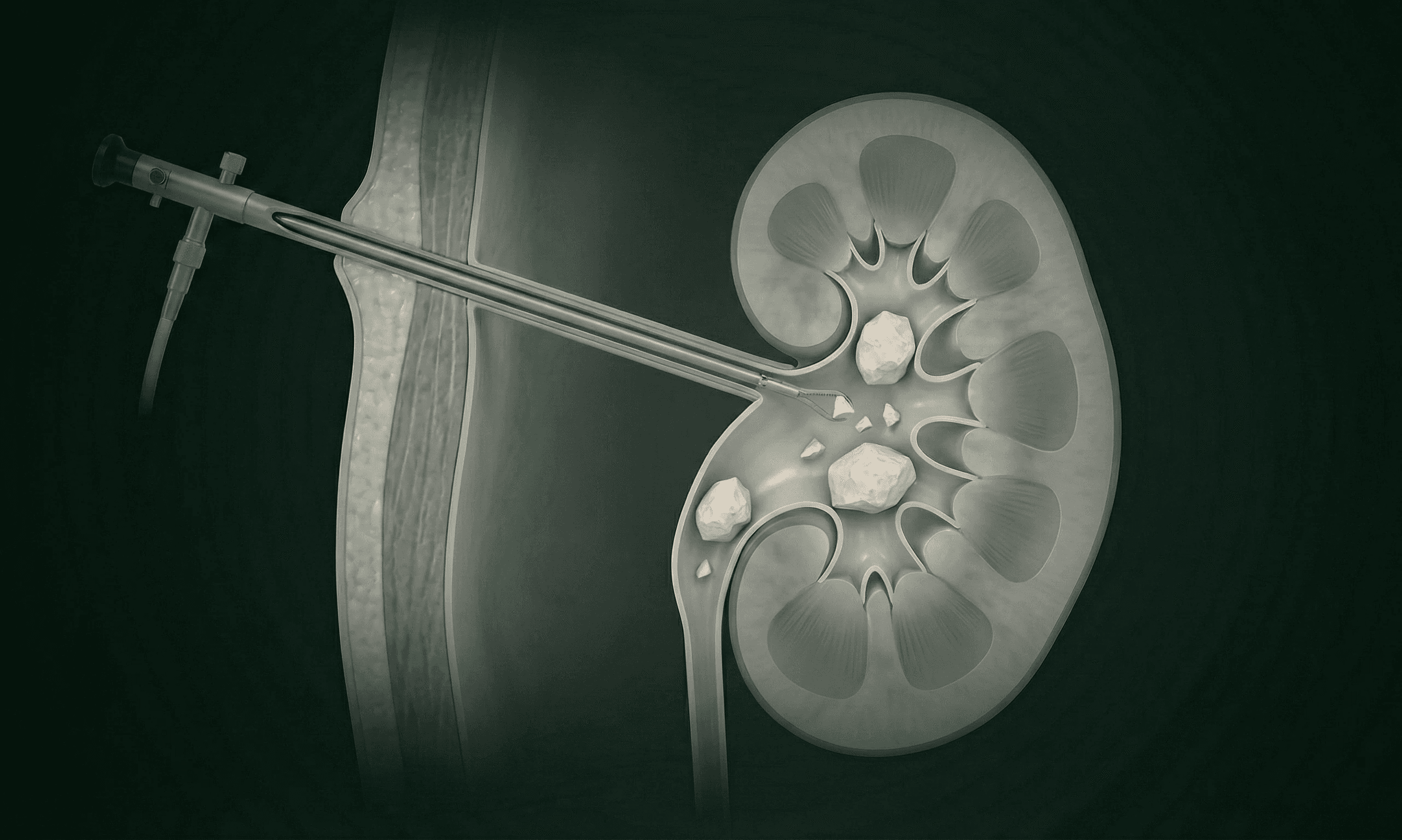
What is this procedure?
Percutaneous Nephrolithotomy (PCNL) is a minimally invasive “keyhole” surgical procedure used to remove kidney stones directly from the kidney. It involves creating a small access tract through the skin into the kidney’s drainage system, allowing stones to be fragmented and removed efficiently while avoiding open surgery.
What conditions does this procedure treat?
PCNL is used to treat:
Large kidney stones
Multiple kidney stones
Complex stone burdens
Stones associated with blockage or infection
Stones not suitable for shock wave lithotripsy or ureteroscopy
Why is this procedure recommended?
PCNL is recommended when stones are too large, too numerous, or too complex to be managed safely or effectively with less invasive treatments. It allows direct access to the kidney, enabling effective stone clearance in situations where other techniques may be inadequate.
This approach is particularly useful for patients with challenging anatomy or a high stone burden.
How is the procedure carried out?
The procedure is performed under general anaesthesia and involves a coordinated team approach.
Imaging guidance is used to gain precise access to the kidney
A small keyhole tract is created into the kidney drainage system
Stones are fragmented and removed through this tract
The procedure is carried out by a combined team of a urological surgeon, radiologist, and anaesthetist
Advanced variations of percutaneous stone surgery may be used depending on stone complexity and patient factors.
Anaesthesia, hospital stay & recovery
Performed under general anaesthesia
Patients are admitted to hospital for treatment
Typical hospital stay is around three nights
Recovery is monitored closely, with attention to kidney drainage and infection prevention
Specialist expertise & advanced techniques
PCNL forms part of advanced stone care for patients with complex stone disease. Specialist expertise allows the procedure to be adapted to individual anatomy and stone burden, including the use of modified percutaneous approaches where appropriate. This ensures effective stone clearance while minimising surgical trauma.
Follow-up & next steps
Follow-up includes assessment of stone clearance and kidney function. Imaging may be performed to confirm successful treatment, and further advice is provided to reduce the risk of stone recurrence and support long-term kidney health.
We’re Here to Help
Get clear guidance and support from Dr Philip’s team.
Experienced clinical team
Patient-centred approach
Clear next steps
[Clinical PROCEDURES]
Explore More Procedures
Ureteroscopy & Uretero-renoscopy
Minimally invasive telescopic treatment used to diagnose and treat stones, blockages, and abnormalities in the ureter and kidney.
Read More
Shock Wave Lithotripsy [ESWL]
A non-surgical treatment that uses focused shock waves to break kidney or ureteric stones into smaller fragments.
Read More
General Urology Operations
A range of endoscopic and surgical procedures to treat prostate, bladder, urethral, and scrotal conditions.
Read More